
.NET
Enterprise applications, APIs, cloud services and business software.
- Example roles
- .NET developer, backend developer, full-stack developer
- Common skills
- C#, ASP.NET Core, SQL Server, Azure, Angular or React
Python is not the only route into software. Understand the available career paths, choose work that fits you, then build focused Microsoft .NET or Python skills through guided practice.
Learn · Practice · Build · Grow · Succeed
decision » role first, technology second.
practice flow
scope » We focus on solid foundations and guided project practice—not promises of instant expertise!
// career guidance
Python, .NET, Java, frontend, databases, cloud — there is more than one way into software. Swipe through to see how we help students pick the right path.
choose a career path, not only a trend
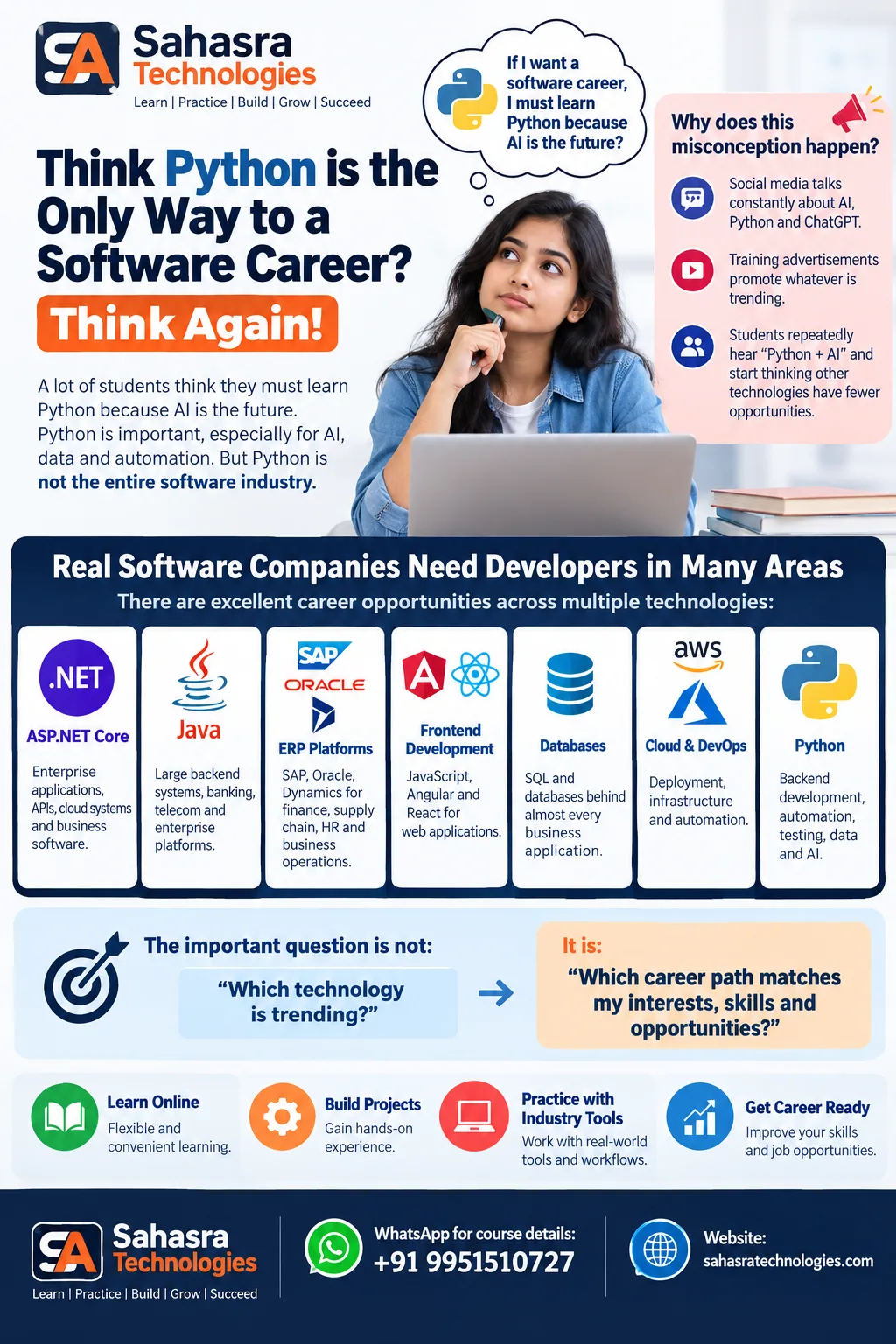
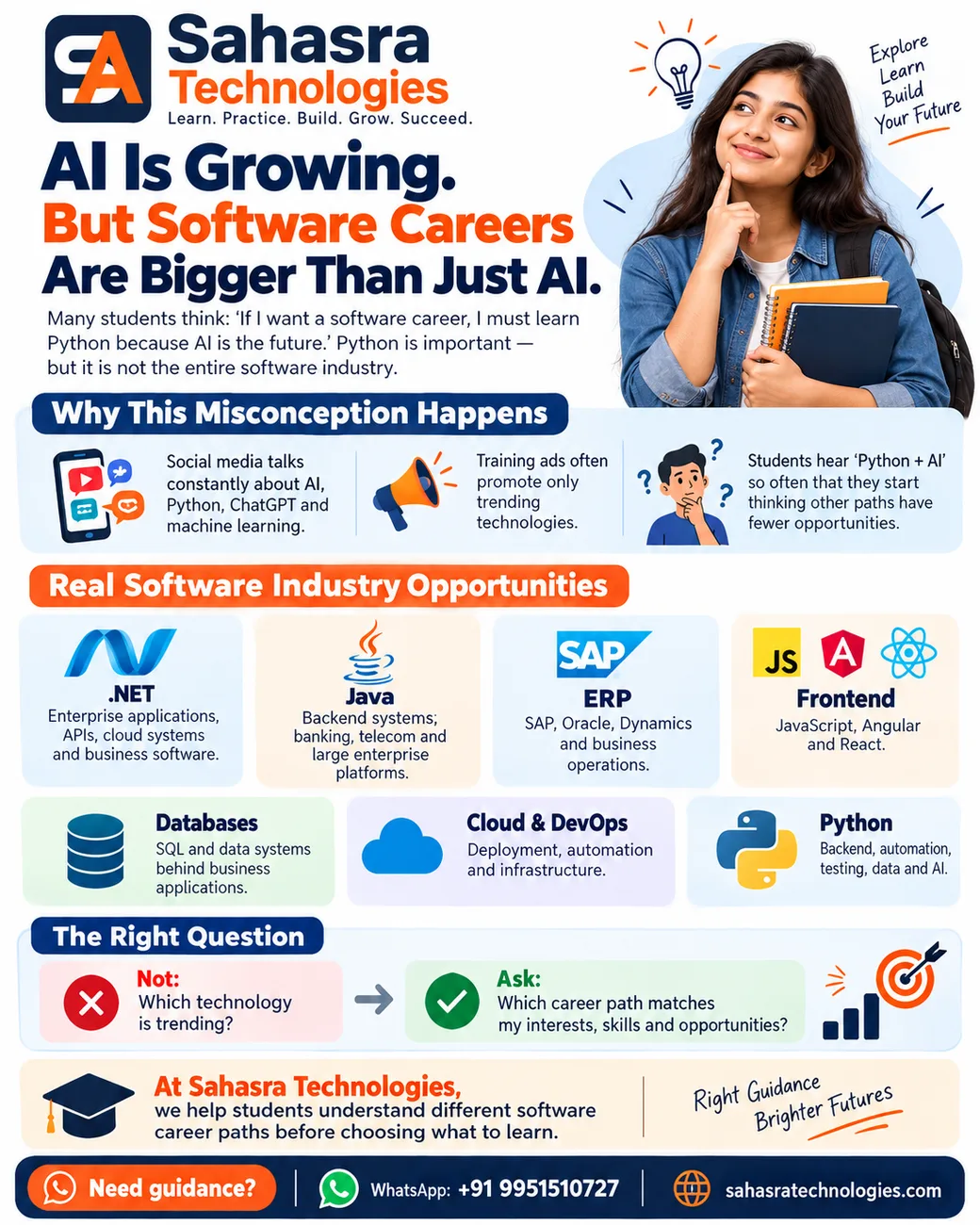
Python is important for backend development, automation, testing, data and AI. But Python alone does not guarantee a job, and it is only one part of the software industry. Employers recruit for many kinds of software work.
The misconception grows because social media and training advertisements concentrate on AI, Python and ChatGPT. Trends can help you discover a field, but they should not choose your career for you.
Enterprise applications, APIs, cloud services and business software.
Banking, telecom, large backend systems and enterprise platforms.
Finance, supply chain, HR, sales and business operations systems.
Web interfaces, dashboards, portals and customer-facing applications.
Application data, reporting, analytics, performance and data operations.
Deployment, infrastructure, monitoring, reliability and automation.
Product quality, test automation, reliability and release confidence.
Backend services, automation, testing, data engineering and AI/ML.
the better question
Which career path matches my interests, skills and realistic opportunities?
There is no universal “best” technology. Start with a target role, then combine the language, database, framework, tools and project skills that role needs.
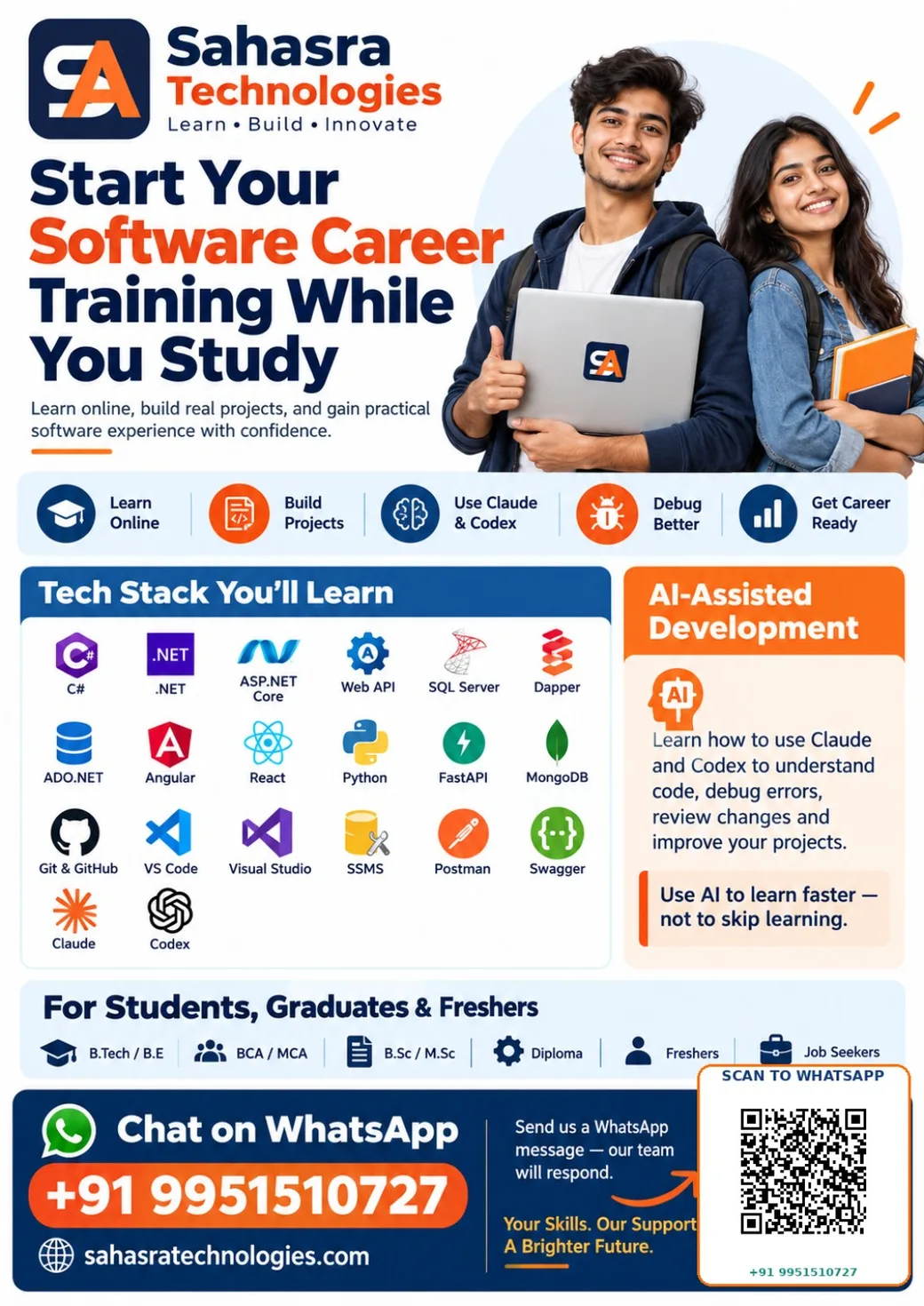
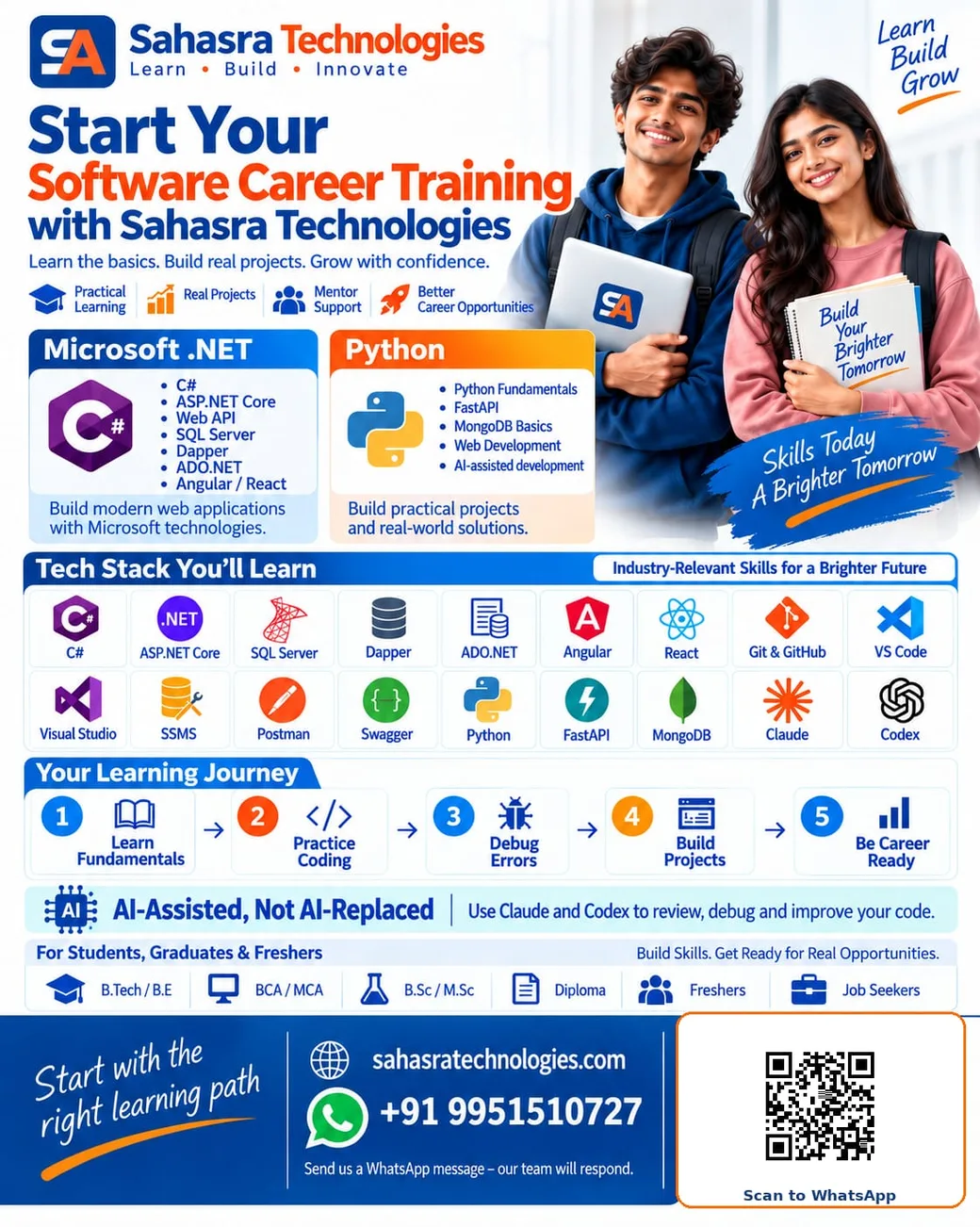
Sahasra Technologies currently provides focused training in Microsoft .NET and Python paths, with supporting frontend, database, Git, debugging and AI-assisted development skills. The wider career map above is guidance—not a claim that every listed technology is taught here or that completing a course guarantees employment.
// your starting point
Choose the current B.Tech or degree year. Each path grows from the student’s present level instead of assuming everyone needs the same training.
Start Building Your Foundation From Year One
View learning path →02Move From Learning Code to Building Applications
View learning path →03Add Practical Development Before Placement Preparation
View learning path →04Connect Your Degree With Practical Project Work
View learning path →05Connect Postgraduate Study With Practical Software Work
View learning path →06Completed Your Degree? Build a More Focused Learning Plan
View learning path →// why now
Numbers from published industry research — each one linked to its source, so you can read the report yourself instead of taking our word for it.
84%
of developers now use or plan to use AI tools in their development process — up from 76% a year earlier.
Stack Overflow Developer Survey, 2025 ↗46%
of survey respondents distrust the accuracy of AI output, compared with 33% who trust it. The survey highlights the need for human verification.
Stack Overflow Developer Survey, 2025 ↗56%
average wage premium reported in 2024 job advertisements requiring AI skills, compared with similar roles that did not, across the industries PwC analysed.
PwC Global AI Jobs Barometer, 2025 ↗39%
of skills required on the job are projected to change by 2030, according to employers surveyed by the World Economic Forum.
World Economic Forum Future of Jobs Report, 2025 ↗170M
new roles are projected globally by 2030 while 92 million are displaced, for a projected net increase of 78 million roles.
World Economic Forum Future of Jobs Report, 2025 ↗57.5M
developers are projected on GitHub in India by 2030, based on GitHub's forecasting models. This is a platform projection, not a jobs forecast.
GitHub Octoverse, 2025 ↗We do not publish placement percentages, student counts or salary figures of our own. When we have verified numbers to share, they will appear here with the same kind of source link.
// what we currently teach
Our main focus is practical Microsoft development and Python programming. SQL, Git and frontend integration are introduced where the chosen path needs them—not presented as separate promises to master everything at once.
From programming basics to a guided Angular or React full-stack application.
View curriculum →02Strong C# fundamentals, practical OOP, collections, LINQ and async basics.
View curriculum →03MVC, Razor Pages and strongly focused ASP.NET Core Web API development.
View curriculum →04Python fundamentals, OOP, files, automation and introductory FastAPI.
View curriculum →05Strong SQL foundations, stored procedures, design and practical query skills.
View curriculum →06Repositories, branches, pull requests, reviews and practical recovery skills.
View curriculum →// what supports each path
These are the supporting skills in our .NET and Python curricula. A language is the starting point; databases, frameworks, Git, debugging, APIs and project work make it useful for a role.
Foundations
Microsoft .NET
Python
Frontend
Data & Databases
Developer Practice
// learn by building
Follow the connected development journey behind a working application—not isolated topics that never come together.
Understand requirements
Plan modules
Design the database
Build ASP.NET Core or Python APIs
Develop frontend screens
Integrate and authenticate
Test and debug
Deploy and explain
// career preparation
Technical training is more useful when you can show your work, describe it accurately and identify roles that match your current skills.
Practise a structured workflow: define the need, review AI proposals and understand each decision before accepting a change.
Read the full methodology →// after the curriculum
Training is half of it. The other half is being able to show the work and explain it under questioning — so that is taught too.
Complete a guided project inside your track with code you wrote, reviewed and understand. Use it as evidence of the work you actually completed.
Read guidance →Turn that work into a resume, GitHub and LinkedIn profile that describe what you actually built, in language a recruiter can follow.
Read guidance →Work through coding, SQL, API and debugging questions, then rehearse your project until you can answer follow-ups without a script.
Read guidance →Search with the right role keywords, apply to openings that match your current level, track responses and close the gaps rejections reveal.
Read guidance →This is preparation and guidance, not placement. We do not promise jobs, guarantee interview calls or make claims about hiring partners.
// roles related to the curriculum
These examples show how curriculum topics relate to common job titles. Completing a track does not establish eligibility or guarantee an interview.
C# fundamentals, ASP.NET Core APIs and SQL Server, applied to a working application.
HTML, CSS and JavaScript foundations before a component framework — Angular or React.
One guided path from language basics to an end-to-end application you can demonstrate.
Relational design, queries and data access with ADO.NET, Dapper or Entity Framework Core.
Python fundamentals with practical data handling across SQL Server and MongoDB.
Reading existing code, reproducing defects, debugging methodically and working with Git.
// why sahasra
#ai
You learn the fundamentals first, then use AI as a tool you direct, verify and debug—not as a shortcut around understanding.
#project
Each core track includes connected exercises and a guided application. Every stage adds a working piece that can be reviewed and demonstrated.
#mentor
Review sessions focus on correctness, trade-offs and clear explanations, so you understand the code you submit and can discuss your decisions.
#stack
Microsoft .NET and Python are the main programming paths. Databases, frontend tools and Git are taught as supporting skills when the project requires them.
online across our region
for colleges and teams
Campus batches, final-year project mentoring, fresher onboarding and focused team upskilling — same curriculum, scheduled around yours.
free resource we recommend
Start with 100+ free .NET articles—no login required.
Tell us what you already know, what you want to build and how much time you can commit. We will help you identify a practical next step.